Mbombo Dream Echoes
Narrative designer for a video game imagining radical Black rest
Commissioned by The Couch at Het HEM
Artist Sondi came to this project with years of research into rest and dreaming as radical forms of resistance against capital and colonial violence on the Black body. She needed someone to build the world in language. I was brought on as narrative designer.
My research took me deep into fugitivity as a conceptual framework — the posture of Black women who have always been engaged in imagining otherwise, surviving apocalypse, moving away from though not necessarily knowing what towards. I read Adrienne Maree Brown, Christina Sharpe, Tina Campt, Tricia Hersey. I met regularly with Sondi as the world took shape, thinking through how the body, nature, and connection could each become conduits for healing in the dreamspace.
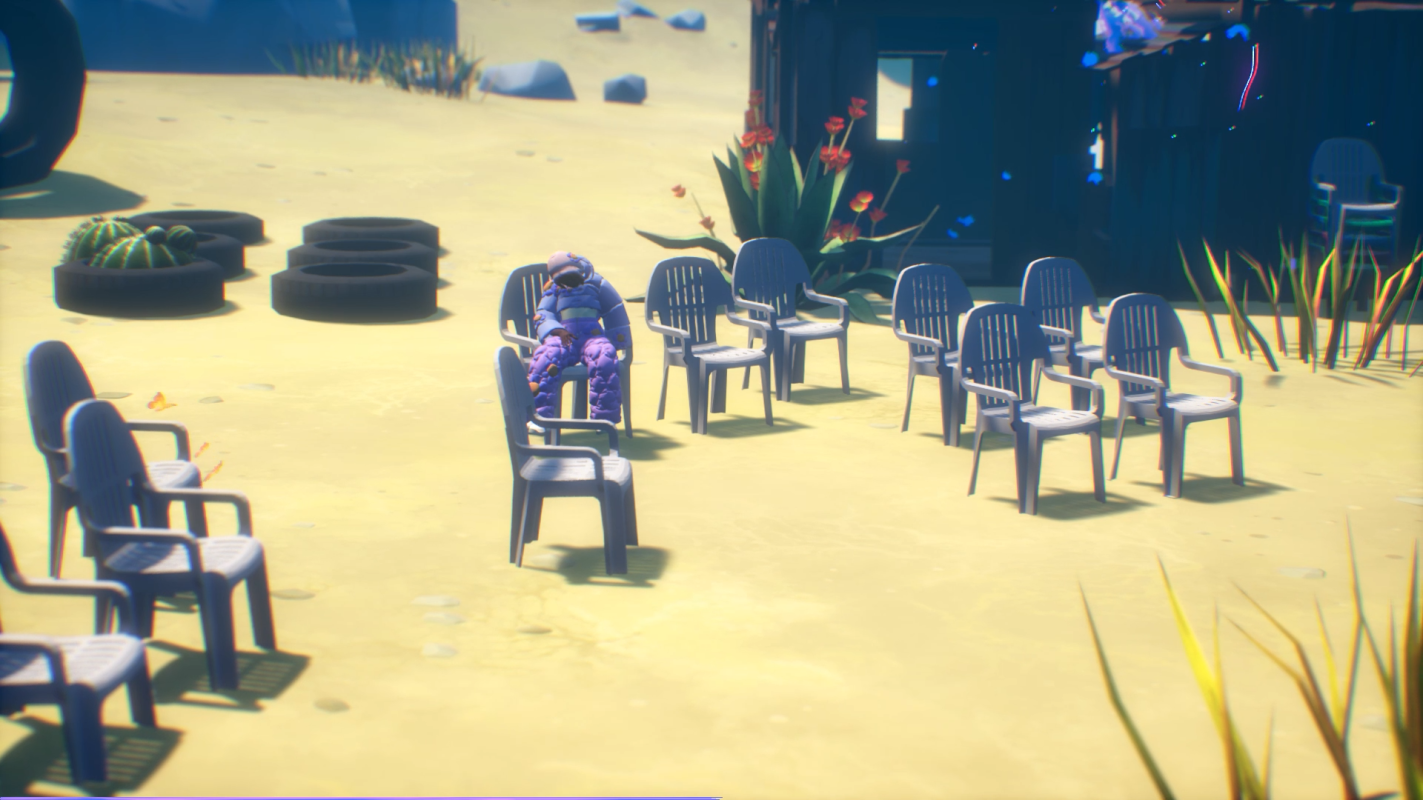
The body was the first conduit. Freed of the weight of oppression, bodies become lighter and more porous. A player who moves too quickly runs out of energy — the game intervenes with a mirror, a moment of self-confrontation. A player who moves slowly goes deeper, falls into meditative states, begins to experience the body as temporary housing for the true self. Over time there is dissolution — a sense of oneness with nature, new possibilities for what this body might become.
Nature was the second. "What we pay attention to grows" governs this space. The longer a player looks at a leaf, the more is revealed. Patterns become paths. Players fall into fractals in a flower and arrive somewhere new.
Connection was the third. NPCs are co-conspirators, companions, co-plotters. When they encounter each other they truly see each other. Their voices are sacred whispers. Ancestors are the most compelling force in the game — felt throughout, encountered only at the deepest level.

The narrative I wrote for the game opens with a world-exhaustion — Black bodies across the globe, centuries of working and fighting, until simultaneously, everywhere at once:
They were headed to work in Khartoum, Kinshasa and Lille or they were on their feet cooking for families in Berlin, Brussels and Tulsa. Perhaps they were protesting in Brooklyn, Paramaribo, and Los Angeles, or they were praying in Gaza, Damascus and Port-au-Prince; almost certainly they were heavy with a load beyond their lifespans in Bahia, Kingston and Mogadishu.
Working, fighting. This they had been at for centuries. Wherever they landed they demanded peace and pay; their voices beaten back by regimes that sought to reconstitute their blackness as mere fuel for the engine of industry.
Their bodies could no longer hold.
An exhaustion spread from the river to the sea… In the mountains and the cities, rural Black people, coastal Black people, farming Black people, millions everywhere all at once took back a breath so deep as to contain the plundered peace of all ancestors.
Wherever they stood it came, suddenly and simultaneously: refusal, refusal, refusal. And in a gust they collapsed into sleep.
I also wrote an accompanying essay — Take what you're owed // Fugitive Dreams — published alongside the game, tracing my own thinking about rest, fugitivity, and what it means to steal back what was taken.