Growth experiments at Flo Health
Narrative strategy, funnel experimentation, and cross-functional collaboration for a women's health app used by 75 million people
Experiment 1: Acquiring new perimenopause users by selling the peri timeline feature
+24% conversion uplift
Challenge My team is responsible for acquiring new perimenopause users and introducing them to Flo's perimenopause mode. The Peri Timeline stages users in their menopause journey — based on how they answer certain questions, an algorithm determines whether they are likely in late reproductive, early perimenopause, late perimenopause, or menopausal phases. The Peri Score measures how much their symptoms are affecting their daily lives.
The aim of this experiment was to introduce the Peri Timeline, a feature that stages users in their menopause journey. Our task was to showcase the Peri Timeline and make the Peri Score land as the solution to a problem users now understood they had.
First iteration We chose the Peri Score funnel, our most successful funnel, as the testing ground for the timeline. It's the funnel where users who want to know if they're in perimenopause end up. I wrote the copy and co-created the design for the first version. We added a staging layer before the Peri Score questions, using the Peri Timeline algorithm to identify where each visitor was in their menopause journey. It failed, the result was a net negative 8% outcome.
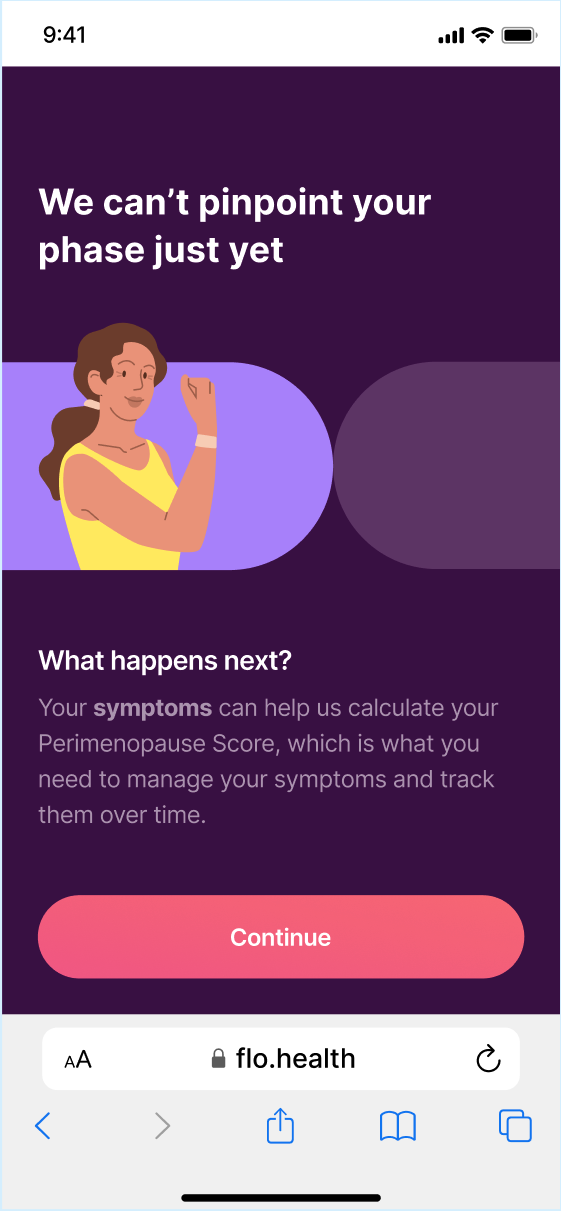
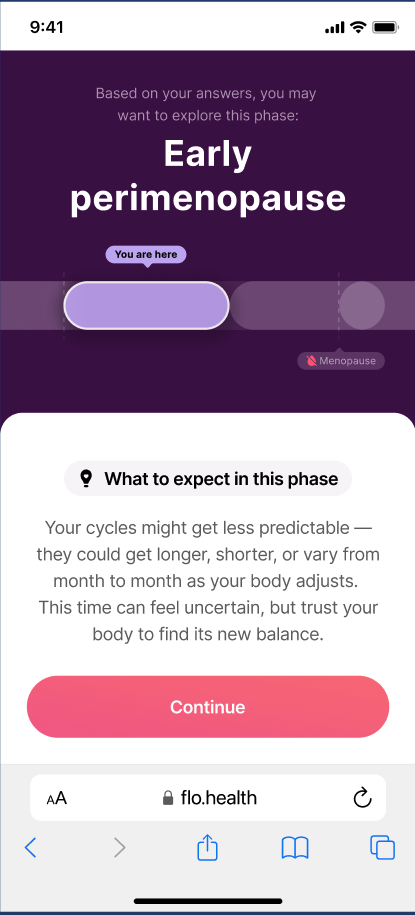
I helped analyze the data to understand specifically what had gone wrong. A key staging question about cycle changes was medically ambiguous, users couldn't answer it confidently, and it had significant drop-off. Around 76% of visitors couldn't be assigned a perimenopause phase at all, creating a dead end in the funnel. The screen confirming the perimenopause phase had a 2.51% drop — users who reached it and saw an early-stage result appeared to feel less urgency to continue. We were losing more visitors overall in the test than in control, around 21% versus 16%.
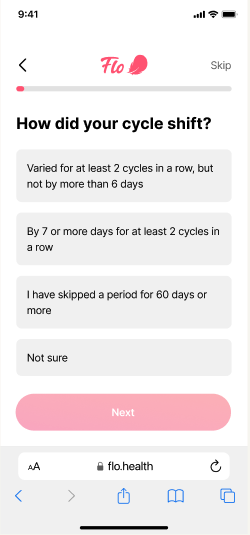
Second iteration I used the data to redesign the experience. I rewrote the ambiguous staging question with the medical team — clearer language, same medical accuracy.
For visitors whose phase couldn't be determined, I removed the phase confirmation screen entirely and moved them straight to symptom questions. For those whose phase could be identified, I consolidated two screens into one, using the title to bridge their timeline result directly into the Peri Score questions.
Working across medical, science, and product simultaneously, the language had to serve the user, satisfy the algorithm, and meet medical compliance requirements all at once.
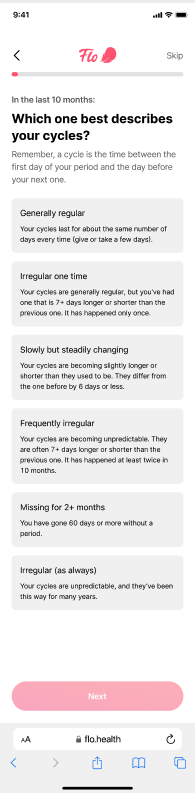
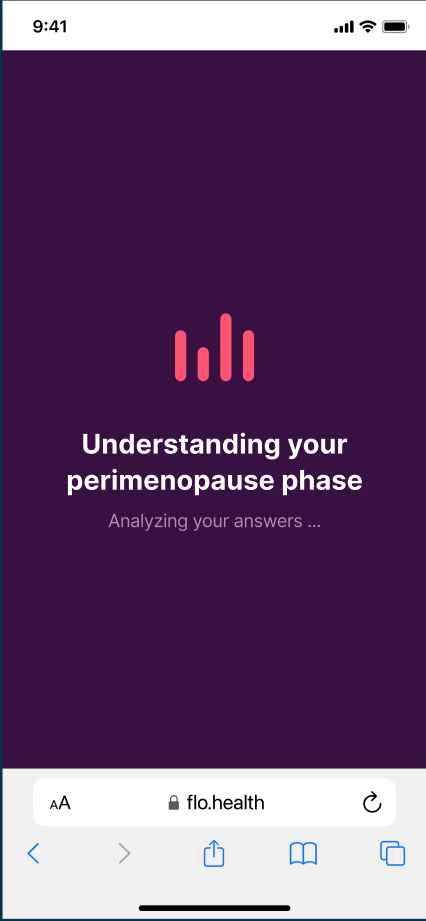
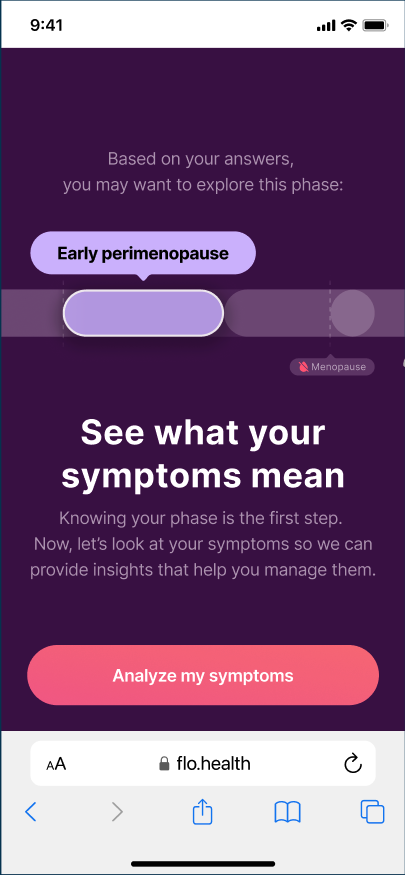
Result The winning iteration drove a +24% uplift in conversion. The biggest driver was the cohort we'd previously lost: visitors whose perimenopause phase couldn't be pinpointed. By removing the phase confirmation for that group rather than showing them an uncertain result, we maintained more of the audience we needed to convert. Only around 11% of visitors were identified as being in early or late perimenopause — meaning the majority of the funnel's performance depended on handling the unclassified group well.
Experiment 2: Unlocking sleep as a revenue stream
50% goal selection rate against a 40% benchmark
Challenge Flo had long wanted to generate revenue as a sleep tracking tool. Four separate sleep funnels had been tested by different designers. All four failed to hit the benchmark. The missing piece, identified by the user acquisition team, was narrative: sleep as a standalone proposition wasn't compelling enough. The strategy was to connect poor sleep to perimenopause.
My task was to translate that strategic insight into the first three screens of the funnel — the welcome animation, age group selector, and goal selector — and test whether users would be persuaded by the combined messaging. If the experiment worked, it would unlock investment in a full sleep survey funnel. If it didn't, sleep as a revenue stream would remain stuck.
My approach Women going through perimenopause are experiencing a battery of symptoms but they aren’t sure what’s peri and what’s not. I wanted to help our audience whose primary complaint was sleep disruption understand that their hormones might be behind it.
I developed user personas to ground the experiment in real user motivations. My narrative angle was: we can help you figure out whether your poor sleep is related to hormones or something else. That framing positioned Flo not as a sleep tracker but as a guide through the confusion of perimenopause symptoms, which is exactly what this audience was looking for.
Because I knew users were arriving through paid ads, I built the content on all three screens to match what the ads were saying, ensuring continuity from the moment a user tapped through.
Result The experiment achieved a 50% goal selection rate against a 40% benchmark. The three screens now exist as the permanent top-of-funnel intro for Flo's sleep survey — the foundation that four previous attempts hadn't been able to build. The successful experiment unlocked investment in the full sleep survey funnel, which is currently in development.
Role Senior Content Designer | Growth | Flo Health Collaborators Senior Product Designer, Senior Product Manager, Medical Advisor, Lead Research Scientist